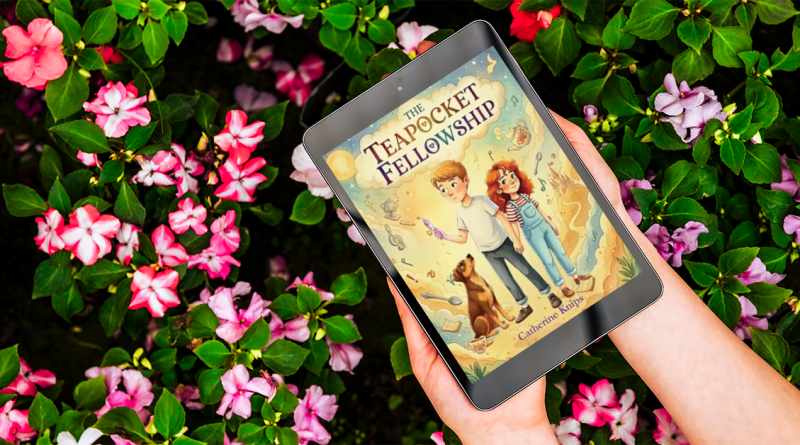
The Teapocket Fellowship – Book Review
Wonderland has always belonged to the wonderfully illogical. In The Teapocket Fellowship, Catherine Knips gives that tradition a clever new complication: what happens when the person holding the pen becomes the greatest threat to the story?
I was very excited to get an ARC (Advanced Reader Copy) of this upcoming book. I’ll tell you everything I loved about it, in this spoiler-free review. And if you want to check it out yourself, it’s available for preorder now with a release date of August 6, 2026.
Let’s dive in!
When a rogue author begins rewriting Wonderland according to his own bitterness, the damage is immediate and delightfully absurd. Kettles lose the urgency in their whistles, flamingos abandon the Queen’s croquet lawn, and dodos search for invisible trains using contradictory timetables. Yet beneath the comic disorder lies a genuine danger. Wonderland is losing the imagination, freedom, and joyful nonsense that make it worth saving.
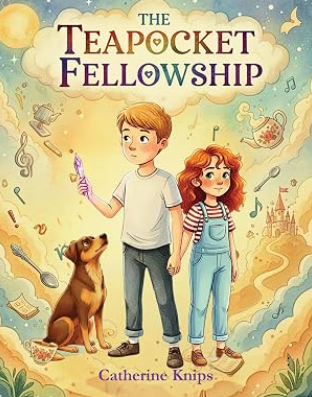
Its unlikely rescuers are Eliza and Hugo, two children whose opposite personalities make them ideally suited to the task. Eliza approaches life with unchecked creativity, emotional openness, and an imagination large enough to make an invisible dog real. Hugo is more cautious and methodical, guided by the Moral Compass that helps him distinguish not only what he should be, but eventually what he must do. One dreams beyond the boundaries of reason; the other provides the judgment necessary to keep those dreams from becoming destructive. Their friendship demonstrates that imagination and responsibility are not opposing forces—they are strongest when working together.
Then there is Noodle, Eliza’s opinionated Labahoula, who quickly becomes one of the book’s most memorable creations. Mischievous, affectionate, and unwaveringly confident in his own brilliance, Noodle provides many of the story’s funniest moments. He is more than comic relief, however. His transformation from an invisible companion into a visible member of the fellowship reinforces one of the novel’s loveliest ideas: sometimes believing in another person’s unusual inner world is an act of friendship.
Memory-storing clouds, emotional teas, living punctuation, scroll-light, enchanted pens, villages powered by tea, and a theme park created to face difficult realities are just a few of the creative details Knips incorporates into her Wonderland. During a shared read-aloud, the humor shifts freely between jokes that adults will enjoy, lively wordplay, and kid-friendly silliness. The outcome feels more than just a repetition of Lewis Carroll’s absurd tradition. This isn’t just another trip to Wonderland; it’s a tale about who owns Wonderland, what writers owe their works, and whether a story that has been harmed can be rewritten with more compassion.
Because the book does not portray Inkthorn as a one-dimensional villain, the rogue author is especially effective. Although his pride, resentment, and need for power have serious repercussions, the narrative progressively exposes the pain that lies beneath his brutality. The Teapocket Fellowship questions whether humility, forgiveness, and belonging can triumph where punishment cannot, as opposed to viewing victory as the total annihilation of an adversary. The book’s exuberant comedy is complemented by an emotional weight that comes from his eventual confrontation with his own decisions.
Another unique aspect is the interactive sections that come after the chapters. Invent Wonderland mischief, create punctuation characters, crack codes, make up imaginary friends, compose songs and rap verses, think about their fears, and ponder forgiveness, courage, and trust. These exercises don’t feel like generic worksheets that are connected to the narrative. By making the reader a potential co-author, they expand on its main idea. That invitation is reinforced by the cozy, vibrant illustrations, which give the book the visual depth of a classic storybook while still being readable by independent readers.
This story offers a brisk and approachable experience for younger middle-grade readers, families looking for an imaginative read-aloud, and children who may feel intimidated by longer fantasy novels. Its short chapters, lively dialogue, abundant artwork, and creative prompts should also appeal to reluctant readers and children who enjoy drawing or storytelling as much as reading.
Funny, generous, and proudly peculiar, The Teapocket Fellowship celebrates the children who imagine differently and the friendships that make room for them. Catherine Knips has created an adventure in which kindness is not passive, imagination carries responsibility, and even an ending is only the beginning of another possible story.
It’s 5 stars from me!