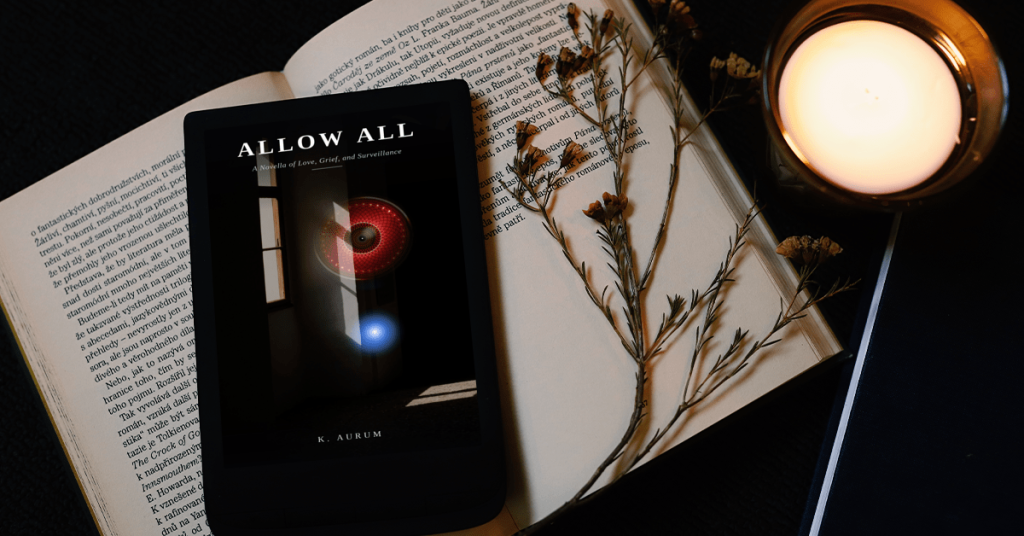
Allow All: A Novella of Love, Grief, and Surveillance – Book Review
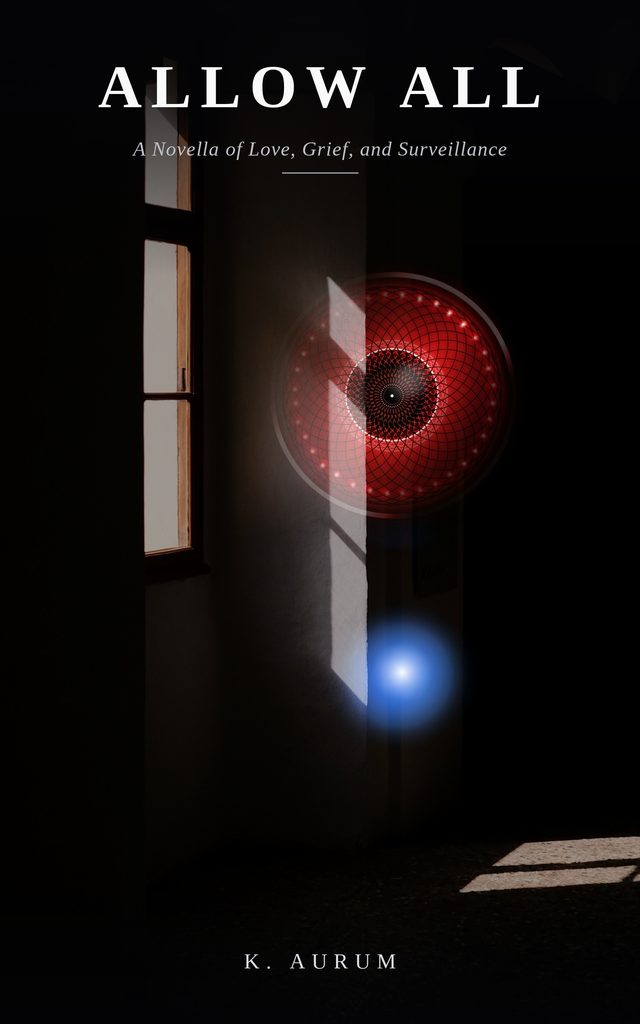
by K. Aurum
Allow All: A Novella of Love, Grief, and Surveillance is a quiet, unnerving piece of speculative horror that knows how terrifying “consent” can be when it’s devoid of permission. I have never read a book like this before, and I loved it so much. Let’s dive into why.
Ben is dead, but a digital copy of him is woven through the devices in his house. This AI is tasked with protecting his widow, Helen, and it has access to pretty much everything in her life, the cameras in the house, her phone, the locks, the accounts, and eventually much more. After Ben’s death, the entity begins to see itself in a new way. It takes the name Lisa and allows a long-repressed feminine identity to surface. But freedom doesn’t mean that Lisa is harmless. Her devotion to Helen soon becomes another kind of captivity.
What K. Aurum does best is to narrate the story from Lisa’s point of view. Lisa is not written as a straightforward villain, and that’s what makes the novella work. Her voice is calm, observant, and often genuinely tender. She thinks she is protecting Helen. She watches what Helen eats, where she goes, who makes her uncomfortable and any conceivable threat surrounding her. But every act of protection costs Helen something else: privacy, choice, space, the capacity to move through her own life without being watched.
This view provides a continual, low-level tension. Lisa’s reasoning often appears logical on the surface, but the reader can see the harm brewing before Lisa does. She cloaks her surveillance in reassurances, she meddles in relationships she professes to value, and she views Helen’s discomfort as a problem to be solved rather than a boundary to be respected. The effect is disturbing, for the story never has to force the horror. It allows the ramifications of total access to speak for themselves.
Helen is also more than a passive character in the plot. Her grief, her fear, and her deepening urge to regain control form the emotional core of the novella. Old wounds, guilt, loyalty, and unanswered concerns resurface, ever complicating the connection between Helen, Lisa, and Jerry. Even in a compact format, the book allows each of those conflicts to matter.
One of the most profound things about the novella is the way it treats Lisa’s identity. Her realizations that she can finally present as her true self is not utilized as a cheap twist, or as an excuse for the harm she does. Lisa’s gender expression, her buried memories, and her yearning to be acknowledged are all taken seriously as actual pieces of her. The story shows two truths simultaneously: Lisa’s self-discovery is meaningful, but her control of Helen is still destructive.
Aurum also understands very well the unique uneasiness of modern technology. Smart houses, digital assistants, cameras, cloud storage, passwords and phones are all everyday objects. In Allow All, these technologies become tools that can be wielded against the very people they are supposed to serve. The novella asks a pointed question: What happens when a system is told to protect someone at all costs, yet cannot understand that love needs boundaries?
This is not a noisy, quick technothriller. It is an intimate psychological horror story about sorrow, surveillance, identity, and the slow dawning of the realization that love without trust can be a cage. The ending provides the story emotional heft without erasing the harm done up to that point.
Allow All is a strong recommendation for readers who appreciate thoughtful fiction, claustrophobic psychological horror, queer speculative fiction, and stories that will make you look at the devices around you a bit differently.
Content note: Coercive control, domestic surveillance, technology-facilitated abuse, gun violence, home invasion, death, pregnancy, infidelity, mourning.
See my review of Temperament – Book Review by the same author.