
Heretical Talk – Book Review
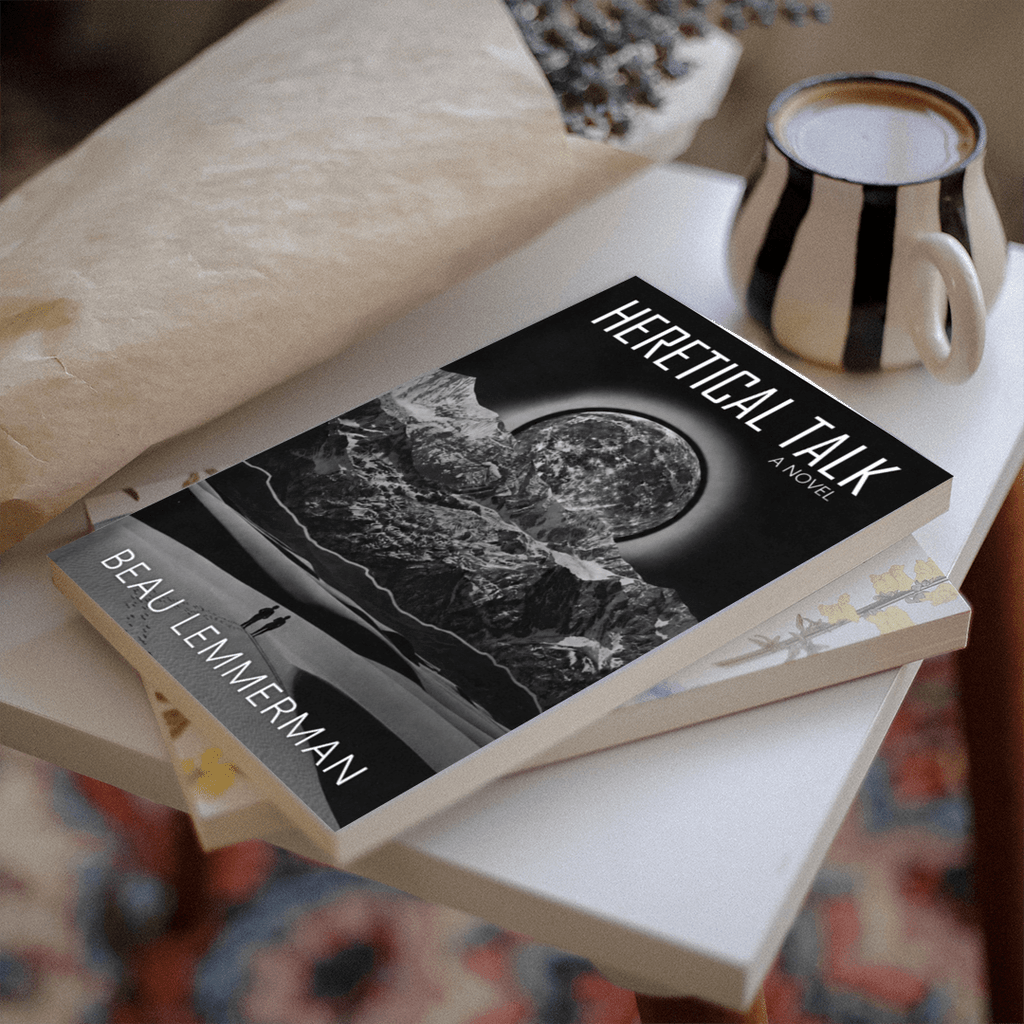
Heretical Talk by Beau A. Lemmerman is ambitious, bizarre, violent, philosophical, and fascinated by the collision of faith, trauma, guilt, anger, love, and the supernatural. A father and son trip to a secluded island and a sinister Halloween event set the scene, but it is only the beginning of a much bigger tale.
Kurt anticipates a diversion and an adventure when he and his teenage son Lachlan arrive at Umbra Island. Instead, they arrive at a location that instantly seems strange: abandoned-looking cars, weird customs, unnerving locals, and the unsettling feeling that something on the island has been waiting for them.
From there, Heretical Talk expands dramatically.
I was grateful to receive a review copy, and I am excited to tell you what I think about it in this spoiler-free review.
A Story that Keeps Expanding
Lemmerman organizes the book into several interrelated sections that go across various individuals, eras, places, and even subgenres rather than adhering to a simple linear horror plot. In one part, it seems like a lonely cosmic nightmare in far-off space.
Another explores questions concerning gods and demons as well as covert experiments. The narrative alternates between violent occult fiction, psychological horror, bleak small-town horror, and something akin to splatterpunk. The recurring figure that ties much of everything together is the enigmatic murderer known as Needless, who develops into a far more complex character than the monster he initially appears to be.
One of the aspects of the book that most intrigued me was its structure. Some of the changes can initially make you feel as though you’ve entered a whole new book. But it’s all for a purpose. The relationships are important, too.
Family, Dread, and Extreme Horror
The opening masterfully establishes that sensation. Before anything paranormal occurs, Lachlan and Kurt already have their own emotional baggage. Kurt views the road trip as a chance to make up for some of the things that have been lost between them, while Lachlan is a blue-mohawked teenage rebel quietly preparing a life apart from his father. Beneath all the strangeness, their dynamic gives the early horror an emotionally recognizable core.
Nearly instantly, the mood around them grows more ominous, particularly after the normally amiable gas station employee silently calls ahead and declares, “Two more heading your way.”
That mixture of character drama and dread runs throughout the novel.
Lemmerman is also not afraid of blood. This is undoubtedly a book for fans of messy, gore-soaked horror. Extreme violence can occur, monsters are hideous, bodies are disfigured, and certain scenes are purposefully uncomfortable. However, rather than feeling like gore added for shock value, the violence typically relates to the bigger issues.
In short, it works.
What Makes a Monster?
A curiously recurring question lies beneath all that blood: What precisely qualifies as monstrous?
Heretical Talk sometimes blurs the distinction between justice and retaliation, human and monster, and victim and criminal. Abuse, abandonment, fanaticism, loss, and grief all influence a character. The book also refers to religion, although not in the straightforward “religion is good” or “religion is bad” sense. After faith fails them, characters either cling to it, reject it, weaponize it, question it, or rebuild it.
The contradiction between belief and real experience is the source of some of the novel’s most unsettling content. Characters who anticipate goodness or divine protection are met with silence, brutality, or hypocrisy instead. The human betrayals that underlie the terrifying otherworldly horrors can be even more horrifying.
The most intriguing manifestation of the concept is Needless.
The novel acknowledges his capacity for horrific brutality. However, his past, grief, remorse, and broken identity complicate what at first glance appears to be a straightforward murderer narrative as the novel progresses. He has evolved into one of those horror characters that are difficult to categorize as either hero or villain by the book’s end.
I particularly enjoyed where he ends up in the last portion.
Without spoilers, the conclusion is worth all the buildup to get there.
And it’s effective.
For a book full of demons, mutilation, cults, serial killers, cosmic terror, and apocalyptic imagery, the climax offers the narrative emotional weight that I wasn’t necessarily expecting. The book’s conclusion unexpectedly addresses the question of whether someone can make a different decision after spending so much of it on characters who are stuck in destructive cycles or immobilized by trauma.
A Wild, Poetic Horror Universe
The text itself has a really unique character. Lemmerman prefers bizarre language, heightened imagery, horrific description, irreverent banter, punk attitude, and religious symbolism. The novel often has the impression of a horror movie filtered through dark poetry, cosmic horror, grindhouse cinema, and underground music. Because Heretical Talk never feels sterile or generic, that style will likely be one of its best-selling features for the right reader.
The novel has a significant poetic component as well. Many of the themes that run throughout the book—such as mortality, religion, identity, violence, societal hypocrisy, divinity, guilt, and transformation—are expanded upon in the collection “Scratches” following the conclusion of the main story. Because of these factors, the book feels less like a traditional horror book with a clear conclusion and more like a whole imaginative universe that extends beyond the story’s confines.
And that might be the most accurate description of Heretical Talk.
It’s not tidy.
It has no interest in being restrained.
Instead, it is a vast horror journey about broken individuals traveling through a world full of monsters, some of which are supernatural, some of which are human, and others of which are impossible to categorize. Slasher violence, occult horror, cosmic horror, dark fantasy, science fiction, psychological horror, and poetry are all mixed together in this work, which gradually reveals how its seemingly disparate chapters fit into a greater mythology.
It’s unlikely that readers seeking subdued, calm horror will find it here.
However, those who want bizarre, violent, philosophical, transgressive horror and are prepared to go well beyond a typical monster tale should definitely check out Heretical Talk.
I recommend for cosmic horror, splatterpunk, occult fiction, interwoven horror stories, morally complex characters, religious horror, punk aesthetics, severe violence, dark comedy, and works that become stranger the deeper you go.
Conclusion
Heretical Talk has the air of a book written by someone who chose not to dilute a very particular universe they had in mind.
It’s memorable because of that confidence.
Beneath the bloodbath, cults, serial killers, demons, and cosmic nightmares, the story is ultimately about people choosing what to become after suffering irreversible scars. Some give in to their injuries. Some people build their entire worldview around these injuries. Some turn into monsters.
And some are able to find an excuse to continue walking.
It’s five stars from me!