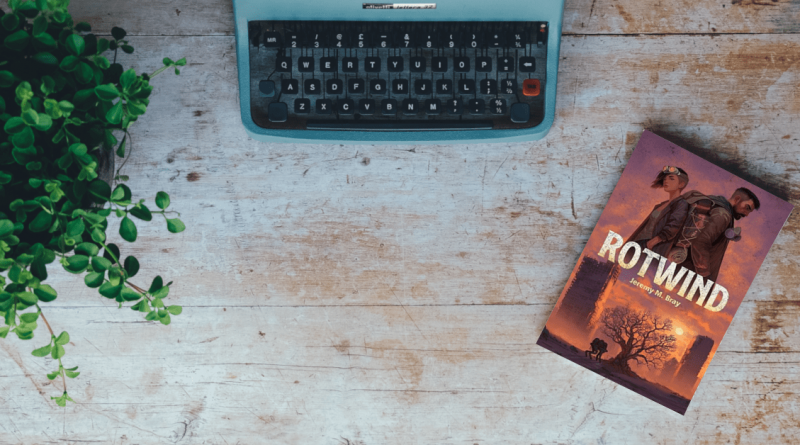
Rotwind (The Rotwind Saga Book 1)
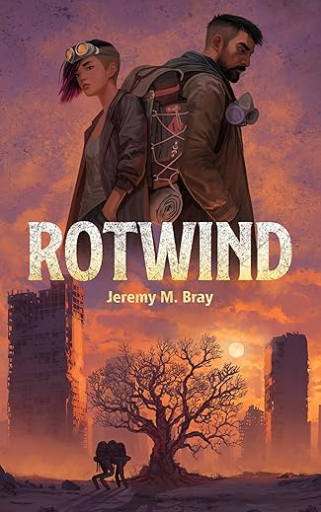
I was very excited to get a review copy of this brand new release, Rotwind. I really enjoyed it and I can’t wait to tell you all of my thoughts in this spoiler-free review.
Quick content/trigger warning: It’s a dystopian, post-apocalyptic story that features an oppressive government and villains who hold bigoted views/oppress minorities. However, the narrative frames these as evil, and the protagonists are fighting against these systems.
This is a somber, dynamic, and unexpectedly personal tale about surviving in a world that was purposefully destroyed rather than simply collapsing.
Jeremy M. Bray makes a debut that is tough without being ostentatious, political without turning into a sermon, and cinematic without being phony. Rotwind is fundamentally a chase story with teeth: a man fleeing a poisoned America with something he shouldn’t have seen while being pursued by orderly systems.
A World That Feels Lived-In and Actively Hostile
The Rotwind plague is more than simply a backdrop catastrophe. It has shaped society. Fungal storms, deserted cities, armed enclaves, and lawless areas seem to be the logical progression of a society that attempted to manage disaster rather than comprehend it. Bray’s worldbuilding is successful because it is restricted. He doesn’t stop the story to explain anything. Rather, details emerge naturally as a result of Morgan Reed’s activity as a survivor and courier. I really felt like I was discovering it all along with Reed.
In this world, infrastructure exists only to support authority, “safe” is a transitory state, and truth itself has become illegal. The New American Republic is much more disturbing than a cartoon villain. It is efficient, bureaucratic, and terrifyingly realistic. The book never lets you forget that this is deliberate, and the notion that genocide could be reframed as “sanitization” feels disturbingly similar to everyday language.
Morgan Reed: A Protagonist Built for Moral Collision
Morgan Reed wasn’t picked. He is neither invincible nor immune to trauma. His code – deliver the gift, safeguard the truth, and survive – and how cruelly it is put to the test are what make him so intriguing. He is already unique due to his survival of the Rotwind epidemic, but what really makes him special is his determination to turn aside after discovering the truth.
Bray steers clear of portraying Morgan as a perfect hero. He is weary, wary, and acutely aware of the price of doing morally. His unwilling transition into a symbol of defiance feels justified. Morgan simply won’t assist in ending the planet; he doesn’t want to rescue it. This contrast is important and lends emotional believability to the narrative.
Vivian “Vex” Song: More Than a Sidekick
It would have been possible to write Vivian “Vex” Song as a trauma-seasoned stock tech genius. Rather, she becomes a fully formed character with her own moral compass, scars, and agency. Her reserved nature makes sense in a society where information is deadly, and her genius is pragmatic rather than ostentatious.
One of the book’s strong points is the relationship between Morgan and Vex. Their bond is based on mutual awareness that survival frequently necessitates compromise, necessity, and trust developed under duress. Any emotional bond that emerges is grounded, not hurried, and never detracts from the stakes. This is not romance for solace, but a partnership under duress.
Tension That Never Lets Up
Rotwind becomes ruthlessly propulsive once the true purpose of the sealed capsule is discovered. Bray is really good at pace. Without feeling episodic, each location – Free City Dulles, Monolith Garrison, and the barren tunnels connecting them – adds a new level of peril. Safehouses are never secure. Allies are always subject to conditions. It is more frightening since surveillance is ubiquitous but uneven.
Additionally, the hunters pursuing Morgan and Vex have identities. State enforcers, corporate kill teams, and mercenaries are all manifestations of the same corruption: power that is unaccountable. Conversations, pauses, and the awareness that every broadcast could be intercepted all contribute to the tension, which is not limited to action scenes.
Themes That Cut Deep Without Preaching
Rotwind is fundamentally about population control, narrative control, and illness control. The apocalypse is reframed as a policy choice rather than a tragedy by the notion that the plague was created and that its return may be used judiciously. That’s unsettling, but Bray manages it well.
In this book, hope is hazardous because it reveals lies rather than because it is naive. Morgan’s voyage makes the reader face an unsettling question: how frequently do nations chose annihilation if it can be rationalized as stability? Carrying the truth is more deadly than carrying a weapon.
The book also examines loyalty in broken systems, including if disappearing is ever really neutral and what it means to protect individuals when institutions are unredeemable.
Style and Craft
Bray writes with clarity and purpose. Because of the intensity of the subject, he prefers clarity over embellishment. The conversation is grounded, the action scenes are easy to follow, and the information is never overdone. Instead of overwriting, the cinematic quality is derived from velocity and organization.
The emotional beats land, which is important. The reader is reminded of what’s at risk – human connection in a world that aims to eradicate it – by brief moments of weariness, uncertainty, and dark humor.
Final Verdict
Rotwind is a perceptive, self-assured foray into post-apocalyptic science fiction that recognizes the genre’s heritage and advances it with wisdom and moral significance. Surviving the systems that promise to restore the world is just as important as surviving the end of the world.
There is much to praise for readers who like character-driven survival stories, courier-style storylines, and dystopian thrillers with conspiracy at their heart. This book treats its readers with respect, has faith in their ability to follow along, and rewards them with a narrative that stays with them long after the last page.
It’s a win from me! 5 stars. You can get it for yourself on Amazon in paperback, Kindle, or Kindle Unlimited.
I love a good sci fi