
In My Mind’s Eye – Poetry Book Review
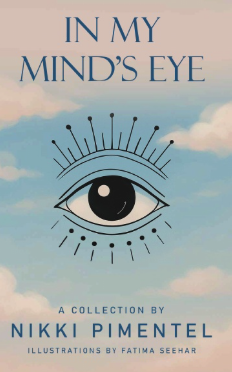
As many of you know, I love poetry. And I try to read as much modern poetry as I can, which is why I was very excited to get a review copy of this new book from Nikki Pimentel. It did not disappoint! And I can’t wait to tell you more about why I was so moved by this collection of poetry in this review.
In My Mind’s Eye is an unvarnished, intensely personal exploration of trauma rather than a gentle introduction to it. In the opening pages, Pimentel describes this book as “a mirror held up to the shadows and light that shaped me”, establishing it as both a testimony and an offering. This framing is important because what comes next is reclaiming rather than merely recounting. And they’ve done such a beautiful job of it!
From the start, a content warning: The poems inside focus on difficult experiences such as childhood trauma, mental health struggles, grief, and loss.
A Voice That Refuses to Stay Quiet
With remarkable clarity, the introductory poem, “Settle In,” establishes the emotional tone. The speaker arrives with “no weapons, no disguises,” bearing stories that were previously suppressed. There is no armor or pretense. It seems to be both an invitation and a warning that you are going to see something genuine.
And that authenticity never falters.
Pimentel’s prose is incisive, frequently caustic, and always deliberate. You may feel the calm power of lines like “Before I knew the words for pain, I already knew how to carry it” long after you’ve turned the page. This poetry transforms trauma into something concrete rather than only describing it. I am still thinking about many of the words I read here, and likely will be for a long time.
Trauma, Identity, and the Body
Pain is not isolated within a single story in this anthology. Rather, it illustrates how trauma permeates identity, family, culture, and self-perception. It’s not something to escape, but something you must learn to live with.
The topics of sexual abuse, body image issues, and bullying in childhood are examined with heartbreaking candor. The reader is faced with the unvarnished mechanics of suffering in poems such as “Childhood” and “Teenage Years”: how words become scars, how quiet becomes survival, and how violation shatters identity.
However, this compilation is unique because it goes beyond that.
It challenges both cultural and emotional inheritance. The second part of the book introduces the idea that we inherit not only customs and recipes but also hidden scars. Ancestral trauma. Something that many of us know well.
It’s a work of self-reclamation and they’ve done this in such a fierce and tender way, it will speak so deeply to those of us who have lived similar lives. And even if you haven’t, this is a book that will give you insight that will help you build compassion and understanding for others around you.
Language as Identity
The seamless integration of English, Spanish, and Spanglish in In My Mind’s Eye is among its most captivating features. It’s authentic. The point is that Pimentel does not translate everything.
Here, language serves as a means of memory, culture, and survival in addition to communication. Some terms are purposefully left untranslated since they cannot be fully translated across languages, as mentioned in the language part of the book. By putting the reader in the transitional areas where identity truly exists, this decision produces an immersive experience.
It’s not just stylistic; it’s philosophical. It’s human.
The Visual Layer: Illustrations & Photography
The images by Fatima Seehar give the collection a new perspective. They echo the poems rather than overpowering them. They are simple, frequently delicate, and serve as visual breaths in between emotional blows.
Words, images, and silence all working together. The images bring the words to life even more.
Healing Without Illusions
The book does not romanticize healing, which is where it differs from some other poetry books. And this is something I love about it. It’s real, raw, and often painful – but moving all the same.
The arc is not tidy. No neat conclusion.
Pimentel, on the other hand, proposes something far more truthful: healing as a spiral, a loop, and something that comes back to haunt you. They claim in “Healing” that healing is a “dance with shadows” rather than a straight line, which seems emotionally and psychologically true. I know, for me, it is.
And yet, despite everything, the collection refuses to end in despair.
It insists on survival.
Lines like “I am not what hurt me. I am what survived” don’t feel like clichés here – they feel earned. Hard-won. Carved out of experience rather than borrowed from it.
Why This Book Matters
Own Voices is more important than ever before. None of the identities represented – Latina, Dominican, LGBT, neurodivergent, and survivor – are flattened by this collection, which sits at their crossroads. Rather, it illustrates how they intersect, clash, and influence one another.
That’s rare.
Books about trauma tend to focus on just one aspect of the subject. The entire tapestry – messy, rich, and incredibly human – is depicted in In My Mind’s Eye.
It talks directly to readers whose experiences have left them feeling divided, invisible, or unheard. By stating, “I see you because I’ve been there too,” rather than by providing simple consolation.
Final Thoughts
You shouldn’t read In My Mind’s Eye lightly. It’s a contemplation, a confrontation, and occasionally a reckoning.
It’s something different, though. It is evidence that even the most shattered tales can be taken back, rewritten, and told aloud.
And occasionally, that’s the real start of mending.
I absolutely loved it! And I will want to read it again and again, especially certain poems that speak to me the most. And I feel like this is one you can read more than once, and get something different from it each time.
Highly recommend!