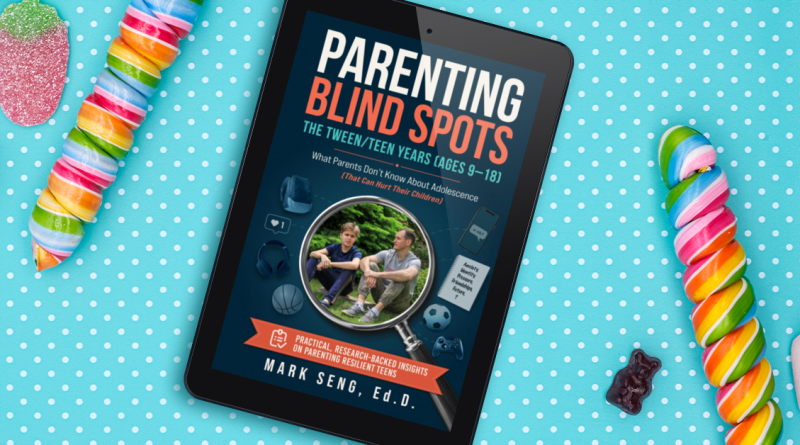
Parenting Blind Spots: The Teen/Tween Years – Book Review
by Mark Seng
I’ve been reading books from the Parenting Blind Spots series by Mark Seng and I want to share my thoughts. Previously, we talked about the early years. Now we are on to the tween/teen age.
You might think you have it all figured out as a parent. The hard part is behind you, right?
Then somewhere between late elementary and high school, a certain breed of parenting panic sets in. Your kid starts to get more private, their friendships seem more complicated, their moods shift without warning, and every conversation is a delicate dance of giving space and checking in.
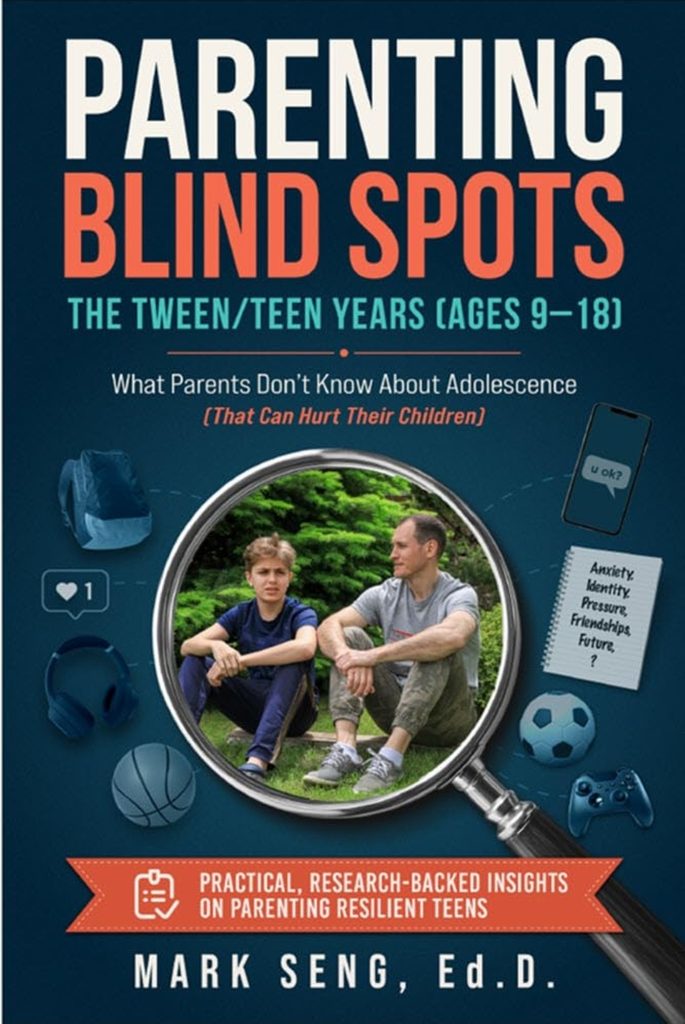
Parenting Blind Spots: The Tween/Teen Years by Mark Seng, Ed.D. is here to meet parents right in that muddy, emotional middle ground—the tween and teen years.
This book is the complement to Parenting Blind Spots: The Early Years. It covers the years nine to eighteen, which may sometimes feel like a long blur of adolescence, eye rolls, and attempts to keep kids off their phones. Seng is much more purposeful. He is aware that a nine-year-old, a thirteen-year-old and a seventeen-year-old are living in very different worlds, and he structures the book appropriately.
That’s one of the book’s greatest assets. Seng doesn’t provide broad guidance for “teens” but thinks of late elementary, middle and high school as distinct developmental stages. He creates space for the fragile self-consciousness of a child on the verge of the tween years, the tremendous social demands of middle school, the rising independence and real-world stakes of high school.
And if you’ve ever been a part of seeing a young person grow through these phases, you will understand why this book is so important.
The title can seem a little daunting at first, but this is not a book to make parents feel guilty for every missed sign or imperfect conversation. Indeed, its core message is rather comforting: raising older kids is not about controlling all risk or having the right answer. It’s about learning to see more clearly, and to be there with curiosity and steadiness and care.
Seng discusses themes that can be intimidating even for the most involved parent: anxiety, withdrawal, academic pressure, peer pressure, cyberbullying, social media, consent, healthy relationships, financial literacy, and the changing adolescent brain. These are not thought of as distant “someday” difficulties. It helps you grasp how issues can start in modest, easily dismissed moments long before they spiral into a crisis.
Each chapter opens with a scenario that seems to be out of real family life, and then unpacks the science of teenage growth in straightforward and accessible language. I enjoyed how the book weaves together what may be happening at home and what a child may be feeling at school, socially and internally. Parents are encouraged to think about their own assumptions and expectations, and how they communicate, without being shamed for doing it wrong.
The practical aspects are extremely valuable. Seng offers practical tactics and language modifications parents can adopt immediately, which is way more helpful than generic suggestions to “communicate better.” The book provides caregivers with a better starting point for a calmer beginning, whether the difficulty is a tense chat about online behavior, a youngster who seems overwhelmed by school, or an adolescent pushing hard for more freedom.
Throughout the book, another welcome thread is the reminder that caregivers need help, too. Raising a young person through almost a decade of significant changes may be hard, perplexing and emotionally taxing. Seng doesn’t forget the parent in the process, and that compassion makes the book feel all the more real.
Parenting Blind Spots: The Tween/Teen Years is a thoughtful, practical resource for parents, caregivers and educators who want to understand the young people in their life better. It does not give a fool-proof road-map to follow during adolescence, since there is none. Instead, it delivers something more useful: a keener awareness, more sympathetic language, and the courage to have the next unpleasant talk.
For anyone raising a tween or teen – and wondering what they might not be seeing yet – it’s an intelligent, encouraging place to start.