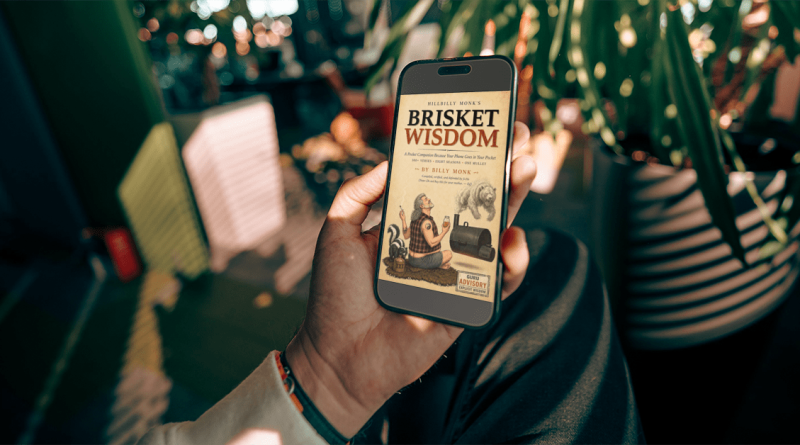
Brisket Wisdom – A Book Review
by Billy Monk
As many of you know, I read a lot of books. And I read a lot of different types of books – fiction, non-fiction, poetry, even children’s books… but there’s nothing I’ve ever read that could prepare me for this one. And I mean that in all the best ways!
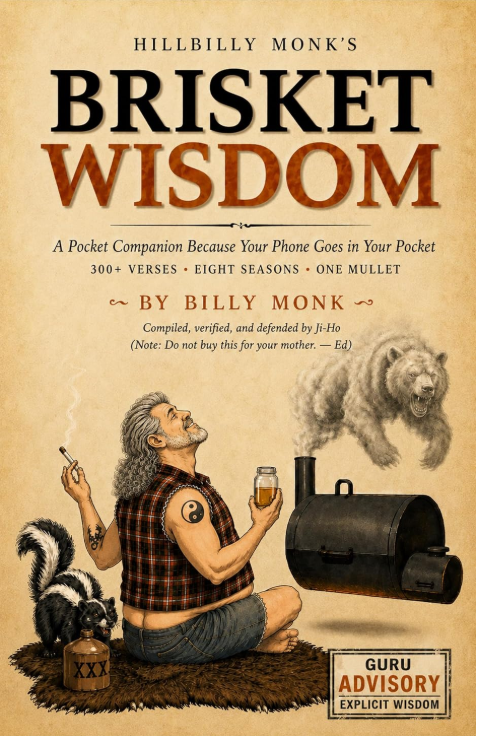
I’m talking about Hillbilly Monk’s Brisket Wisdom, a book where a moonshine-drinking, brisket-smoking Oklahoman mystic tries to explain Carl Jung, Rumi, Pleiadians, religion, relationships, personal growth, bears, bathroom etiquette, and the meaning of life as his increasingly exasperated wife leaves editorial notes in the margins.
So… yeah. This one’s going to need a little explaining.
The idea is that Billy Monk hosted a YouTube show called Brisket Wisdom for eight seasons. The channel is gone, Billy remembers virtually nothing he said on it, and, lucky for humanity, a South Korean superfan named Ji-Ho spent years transcribing Billy’s philosophical ramblings.
So here they are, all these holy writings.
And by ‘sacred texts’ I mean things like Billy wondering if other people have manifested his back fat into existence.
This book knew what it was doing from page one.
Even the intro material is funny. Billy’s wife, Dee, and reluctant editor, tells us the wisdom was delivered while Billy was, at one time or another, under the influence of moonshine, pot, shrooms, DMT, or some combination of the above. And if you read Billy’s wisdom back to him sober, he wouldn’t even recognize it, she said. Her editorial comments are sprinkled throughout the book whenever she comes across something she just can’t let pass without comment.
My favorite part of the whole thing might be Dee, actually.
Billy will be in the midst of some big spiritual revelation, and then the book will just have his wife lean into frame and say, “No way!”
It’s not so much reading a traditional humor book as it is finding eight seasons of the weirdest cult YouTube series that somehow never was.
Brisket, Jung and Dubious Enlightenment
The genius of the book is that Billy’s philosophy is absurd until it suddenly isn’t.
One minute he’s asking himself if aliens might really be angels.
Next he talks about the things we see in others that they cannot see in themselves and whether our role should be to act as kinder mirrors for each other instead of immediately judging what we see.
And then a bear comes out of the smoke, and Billy runs because he is very high.
This is all the time.
Billy takes something mundane, usually brisket, family life, bodily functions, wildlife or some unfortunate combination of those, follows the thought much farther than any reasonable person, somehow wanders into philosophy and occasionally lands on something genuinely insightful.
His philosophy of failure is to eat your terrible first brisket. Tossing away your mistake means you learned nothing from it. Among his thoughts on difficult conversations is the very sensible observation that bears are things you should actually run from, while uncomfortable conversations generally do not have claws.
His theory of personal courage eventually becomes “risk it for the brisket,” which begins as barbecue advice and becomes a surprisingly good argument for letting people see you try things you might fail at.
Again and again I had the profoundly irritating experience of thinking, “That is totally stupid”.
Approximately thirty seconds later, followed by:
“Hang on.”
Because actually… Billy is onto something here…
It is also a lot more structurally clever than it first appears.
Brisket Wisdom looks like a book you can pick up anywhere, open to any page, read three insane observations, laugh, and then put it back down.
The book specifically says not to do that.
Ji-Ho says the verses need to be read in order, and he’s right. What begins as a number of disconnected comedy sketches gradually turns into a real story. Billy kicks off the show with his kids in tow. Rusty works the camera. Morgan has some questions. Dee is close, maybe rethinking every decision that brought her here. Then the tide turns.
I’m being deliberately vague, because part of the book’s success is in finding that change. And I don’t want to spoil that experience for you.
There is a reason that one chapter is called The Book of Burned Ends, and there is a reason that Ji-Ho calls it the darker part of Billy’s story. What begins as a ridiculous fake compilation of mystic YouTube transcripts turns into something about family, ego, identity, the stories we tell ourselves about ourselves, and what happens when personal growth becomes something you’re always talking about instead of actually doing.
That last point is important.
Billy can turn anything into a lesson in self-awareness. The problem is that being able to explain self-awareness and actually being self-aware are two very different things.
That’s where the book gets interesting in a surprising way.
And yes, it’s really funny.
Humor is ridiculously subjective, so I’m always suspicious of things that proclaim themselves to be laugh-out-loud funny.
It had it coming.
There were a lot of smaller jokes I liked, but what really sold me on it was the commitment to the bit. The book is never embarrassed by its absurdity.
Ji-Ho regards Billy Monk as a significant spiritual teacher.
Billy regards his smoker as an oracle.
Dee puts it all away as evidence for some divorce lawyer in the future.
Meanwhile, Billy is earnestly trying to reconcile Jungian shadow work with feuding roosters, explaining the emotional needs of brisket during “the stall,” coming up with business ideas for dog mortgages, giving bathroom advice, working through his generational feud with bears, and wondering if David Bowie was trying to tell us something about the Pleiades.
There is even a long philosophical discussion about a bathroom technique that I will not detail here other than to say that Billy eventually ties it to kindness.
The strangest thing is that Billy’s voice doesn’t change that much. This is not just random vulgarity for the comedy. There’s character underneath. Billy is curious, sometimes insightful, often ridiculous, stubborn, loving, defensive, insecure, and absolutely convinced the universe might explain itself if he gets sufficiently elevated and stares long enough into his smoker.
You can laugh at him, but still get oddly invested in him.
That’s a lot harder to do than just writing jokes.
The heart arrives unannounced.
This is the part I probably did not expect.
Underneath the mullet, moonshine, brisket hospice, DMT, star beings, and ongoing bear grievances, there’s a family story. And you slowly start to see that Billy’s quest for enlightenment affects the people standing around watching him quest.
There are some really sweet moments with Rusty and Morgan. There are funny moments with Dee because you can sense twenty years of marriage boiled down to one editorial comment. There are also times when Billy comes too close to the truth about himself, and the joke suddenly stings a little.
Ah, haven’t we all been there at some point?
The comedy never gets lost in the book to achieve that.
For me that was important. It doesn’t suddenly turn into a different book and announce that it has Serious Things To Say Now.
Billy is still Billy.
He’s just beginning to understand that all those lessons about shadows, sacrifice, acceptance, failure and love might just be for him.
Unfortunately for Billy Monk, enlightenment seems a whole lot easier when talking about someone else’s problems next to a brisket.
Closing Thoughts
Hillbilly Monk’s Brisket Wisdom is profoundly weird, often filthy, surprisingly thoughtful, and nothing like anything else I’ve reviewed.
It functions as absurdist comedy. It functions as a character piece. “It’s a satire of internet gurus and spiritual certainty.” And somewhere under all that, it’s also a story about a family changing while one man is busy trying to figure out the universe.
I came in expecting brisket jokes and a shit ton of bullshit.
I also got Carl Jung, queer kids, spiritual aliens, marriage problems, emotional growth, cosmic dogs, bathroom philosophy, a suspicious number of bears, and a few bits of advice that had no business making as much sense as they did.
For the mullet!
You hang around because you begin to give a damn about Billy Monk as a person. And that, I would say, is a job well done.
5 stars from me!