
From Closing Cases to Closing Deals: A Different Way to Think About Sales
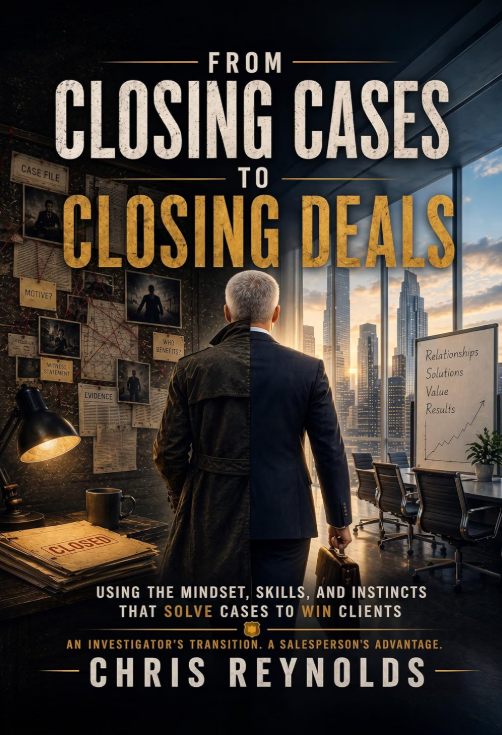
I’ve been a small business owner for over 25 years now, and it’s safe to say, I’ve read a lot of business books over the years. But there’s something really unique about this one, and I can’t wait to tell you more about it. Many books that promise the secrets to how to be a better salesperson have scripts, closing techniques, objection handling, and sales funnels.
Chris Reynolds takes a very different approach in From Closing Cases to Closing Deals: How 30 Years in Law Enforcement Unlocked the Secret to Authentic Sales Success.
And that difference is exactly what makes this book worth reading.
Drawing on three decades as a detective with the Gaston County Police Department, Reynolds makes a compelling case that some of the most valuable sales skills have very little to do with selling at all. They have to do with listening, observing, developing rapport, recognizing what people actually need, and earning trust.
I was so intrigued by this, and had to read more.
From the Interview Room to the Sales Room
The premise of From Closing Cases to Closing Deals is immediately interesting: What can an experienced detective teach us about sales?
As it turns out, quite a lot.
Reynolds spent 30 years learning how to walk into rooms with people who had every reason not to trust him and find a way to establish enough rapport that they would talk. One of the book’s central lessons comes from that experience: you don’t necessarily need to talk more to get someone to open up. Sometimes you need to talk less.
Reynolds describes learning to recognize body language, pauses, changes in answers, and other subtle signals. More importantly, he learned to be comfortable with silence rather than rushing to fill it. That ability became one of the most important tools he carried with him when he eventually left law enforcement.
It is a surprisingly effective foundation for a book about sales because it turns the traditional sales conversation upside down.
Instead of asking, How can I convince this person to buy?, Reynolds encourages readers to ask, What does this person actually need?
That shift is at the heart of the book.
A Second Career at 50
One of the most engaging parts of the book isn’t actually about sales. It is about starting over.
After retiring from law enforcement at 50, Reynolds initially found himself without the structure and identity that had defined most of his adult life. His wife, Erika, eventually confronted him about what he was going to do next and challenged him to think about what he was actually good at.
That conversation becomes a turning point.
Rather than telling him to reinvent himself completely, Erika encouraged him to recognize that the skills he’d developed during his law-enforcement career could have value somewhere else. Reynolds realized that while he had spent decades thinking he was good at police work, the deeper skill was his ability to understand people, establish trust, read a room, and communicate with strangers.
That is a particularly encouraging message for anyone facing a career transition.
Your previous career doesn’t necessarily become irrelevant when you leave it. You may simply need to recognize which skills belonged to the job and which skills belonged to you.
I actually really loved this because I retired from content marketing/copywriting to become a full time fiction author, and I definitely use all of my marketing skills from my previous career to help me marketing my own books (and those of other authors).
Throwing Out the Sales Script
When Reynolds entered the insurance industry, he was given the kind of structured sales process many new representatives receive: a script, a sequence, product information, objection handling, and a closing process.
The problem was that Reynolds didn’t believe the script reflected how people actually make decisions.
His solution wasn’t to stop selling. It was to stop leading with the sale.
He began conversations by learning about the person sitting across from him. What mattered to them? What were their concerns? What did they need? Only after establishing that understanding would he determine whether what he was offering actually fit.
And the results were remarkable.
Reynolds went from having zero professional sales experience to becoming Aflac’s number-one sales representative in North Carolina during his first year.
That achievement gives the book’s central argument considerably more weight. Reynolds isn’t simply saying that authentic selling sounds nicer than aggressive selling. He’s showing readers what happened when he actually put the philosophy into practice.
The $400,000 Lesson
One of my favorite stories in the book is the account that begins with something as simple as noticing names on trucks.
While working in insurance, Reynolds began paying attention to independent contractors operating delivery trucks. Instead of dismissing them as passing traffic, he recognized an opportunity and started keeping track of the businesses he saw.
Eventually, he pursued a relationship with a contractor connected to FedEx Ground.
Getting through the door wasn’t easy. Reynolds encountered gatekeepers and plenty of reasons to walk away. But he kept showing up without becoming pushy. Eventually, someone gave him an opportunity to sit down and talk.
And when he got there, he did what the book repeatedly tells readers to do: he listened.
That relationship ultimately expanded into business involving independent contractors across several southeastern states and generated more than $400,000 in business.
But Reynolds doesn’t present the $400,000 as the real lesson.
The lesson is what happened before the money.
He earned trust.
The Chapter About Losing a Sale May Be Even More Valuable
Another strength of the book is that Reynolds doesn’t only tell readers about his victories.
Chapter 9, “The Sale I Lost,” may actually be one of the most useful chapters for anyone working in sales.
Reynolds tells the story of a promising prospect named Gerald. The conversation had gone well, but Gerald wanted time to think and discuss the decision with his wife. Reynolds respected that request—but then he got busy.
He didn’t follow up.
Another salesperson did.
Gerald became a lost client, but Reynolds realized afterward that he had lost much more than a single sale. He had potentially lost an entire network of future referrals.
The experience changed his approach to follow-up permanently. Reynolds came to see follow-up not merely as a sales tactic but as an obligation to someone who has already given you their time and consideration.
That is a useful distinction.
Instead of viewing follow-up as pestering someone until they buy, Reynolds reframes it as simply keeping your word and maintaining the relationship.
It’s one of those ideas that sounds obvious until you realize how often people fail to do it. It also helps reframe some of the “ickiness” that we are taught to feel around sales tactics like the follow up.
Sometimes the Answer Really Is: Pick Up the Phone
The following chapter builds on that lesson.
At Culligan, Reynolds encountered a group of customers who had effectively been written off because the company had allowed its relationships with them to go quiet. Rather than treating those customers as lost causes, he started calling them.
Not to aggressively sell them something.
To reconnect.
Within ten months, sales had increased by more than $500,000 from that existing customer base.
That story reinforces one of the book’s strongest themes: relationships don’t necessarily disappear just because communication stops.
Sometimes the door isn’t locked. Nobody has knocked on it lately.
You Don’t Have to Be a “Salesperson”
Chapter 11 takes the idea even further.
Reynolds tells the story of a young man who called him and admitted that he didn’t think he could sell. Reynolds’ response was essentially that this might be good news, because selling isn’t about talking people into things.
Instead, he helped the young man recognize skills he already possessed through athletics: discipline, persistence, preparation, and the ability to keep working when the results weren’t immediate.
The young man eventually produced more than $800,000 in sales during his first year.
Again, Reynolds isn’t suggesting that everyone who reads the book will suddenly produce an $800,000 sales year.
The more important takeaway is that the young man’s success came after he stopped trying to imitate a stereotypical salesperson and began applying his own strengths to the process.
That is a much more interesting message than simply “work harder.”
A Book About More Than Sales
By the final chapter, From Closing Cases to Closing Deals has expanded beyond being a sales book.
It becomes a book about reinvention, confidence, communication, and recognizing your own potential.
Reynolds envisions eventually bringing these ideas into classrooms, businesses, universities, organizations, and other environments where people are struggling with sales processes that don’t fit them. His goal isn’t to replace one rigid script with another. Instead, he wants readers to understand the underlying principle: put the person first, understand what they need, and serve that need honestly.
That makes the book especially appealing to people who have ever felt like they weren’t naturally suited for sales.
Maybe the problem isn’t that you can’t sell.
Maybe you’re trying to sell in a way that doesn’t fit who you are.
Final Thoughts
From Closing Cases to Closing Deals is an engaging combination of memoir, career-transition story, and sales philosophy. Even with my prior experience in business, I felt like I learned a lot from this book.
What makes it stand out is that Reynolds doesn’t present his ideas as abstract theories pulled from a business textbook. He builds them around experiences from three very different stages of his life: law enforcement, sales, and mentoring others.
The stories give the advice context, while the recurring themes—listen more, observe carefully, build trust, follow up, recognize your strengths, and put the other person first—give readers ideas they can actually apply.
Perhaps the biggest message is also the simplest:
The skills you’ve developed aren’t necessarily confined to the career where you learned them.
Reynolds spent 30 years developing his ability to understand people in interview rooms. Then he carried that ability into sales and discovered that the room had changed, but the fundamental human interaction hadn’t.
That’s an encouraging thought for anyone standing at a career crossroads, struggling with sales, building a business, managing a team, or simply trying to become better at communicating with other people.
If you’re tired of sales advice that revolves around pressure, scripts, and complicated closing formulas, Chris Reynolds offers a refreshing alternative: stop trying so hard to sell, and start paying attention to the person in front of you.
That may be the most valuable sales lesson of all.
Rating: 5 stars
Disclosure: This review is based on an advance copy of the book provided for review.