
Η ελαφρότητα του βλέμματος Brings Portuguese Poetry Into Greek
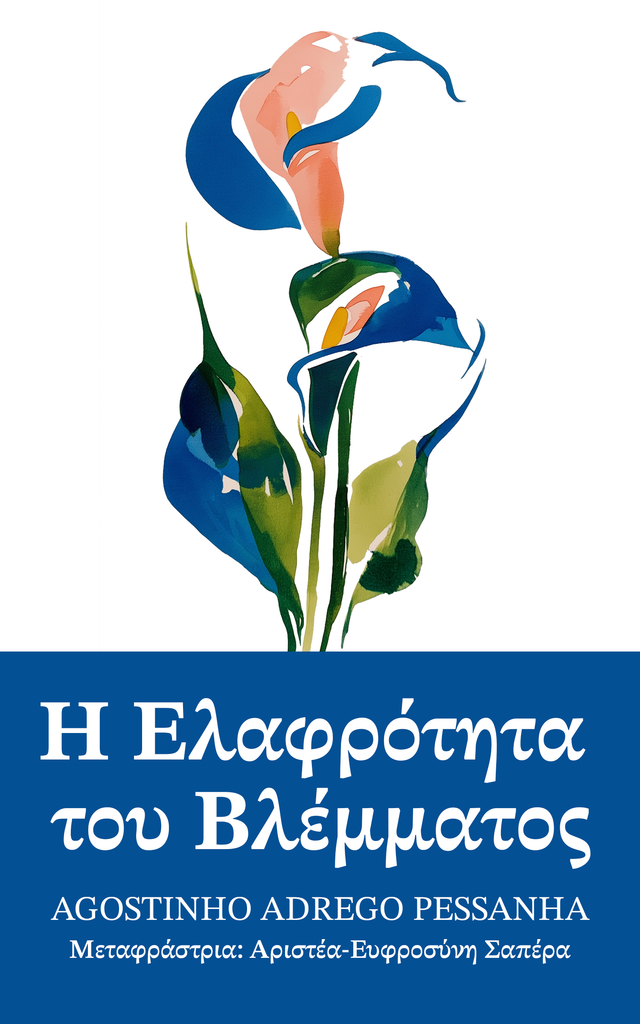
Agostinho Adrego Pessanha’s contemplative collection crosses a new linguistic border through Aristea-Effrosyni Sapera’s translation and the EU-supported Trans-European Journey project.
Poetry often lives in the smallest turns of feeling: a remembered glance, a quiet absence, a moment whose meaning arrives only after it has passed. In Η ελαφρότητα του βλέμματος, the newly published Greek edition of A Leveza Do Olhar, Portuguese poet Agostinho Adrego Pessanha explores those subtle emotional spaces through reflections on love, memory, longing, healing, and the passage of time.
The collection is now available to Greek-language readers in a translation by Aristea-Effrosyni Sapera, published by Letras Ausentes. The edition is part of Trans-European Journey, a three-year literary translation and cultural-exchange initiative co-funded by the European Union through the Creative Europe programme. That context matters: this is not simply a new edition of a poetry book, but an example of what becomes possible when literary translation is treated as essential cultural work.
A Poetry Collection Built Around Attention
Pessanha’s poetry turns its attention inward without losing sight of the everyday world. The collection considers love as more than romance. It can be a source of longing, certainly, but also a path toward self-knowledge, emotional repair, and a deeper understanding of the relationships that shape us.
Memory carries similar complexity. It preserves tenderness, but it also reveals how people and experiences continue to change inside us long after a moment has ended. Across the collection, ordinary observations become openings into larger questions of identity, personal growth, human connection, and what it means to find beauty amid life’s complications.
This makes Η ελαφρότητα του βλέμματος especially well suited to readers who appreciate contemporary poetry that is intimate and emotionally resonant without being deliberately obscure. Its appeal lies in reflection rather than spectacle. These are poems for reading slowly, returning to, and allowing to settle.
What Translation Makes Possible
A poem does not travel between languages through word-for-word substitution. Sound, rhythm, implication, imagery, emotional temperature, and cultural context all have to be considered together. The translator must remain attentive to the original voice while also creating a work that feels alive in the language of its new readers.
That responsibility makes Aristea-Effrosyni Sapera’s role central to this Greek edition. Her work gives Greek readers access to Pessanha’s poetry while carrying forward the sensitivity and emotional depth associated with the Portuguese original. The result extends the life of the collection and creates a new meeting point between Portuguese and Greek literary cultures.
Meet Greek Translator Aristea-Effrosyni Sapera
Sapera works professionally across Portuguese, English, and Greek. She graduated from the Department of Philology at the National and Kapodistrian University of Athens and earned a master’s degree in Classical Literature from University College London. Her academic grounding is joined by the lived linguistic knowledge she has developed as a permanent resident of Portugal since 2010.
Her professional training includes Translation and Language Information Technologies through the Camões Institute, along with Subtitling Translation and Audiovisual Translation at the National and Kapodistrian University of Athens. She has worked with embassies, universities, and Portuguese public institutions, and her experience also includes television-script translation. Since 2024, she has been a member of the Portuguese Association of Professional Translators and Interpreters, known as APTRAD.
That combination of philological study, classical-literature expertise, professional training, and long-term immersion in Portugal is particularly relevant to a collection rooted in nuance. Translating introspective poetry requires more than technical fluency; it requires an ear for what is expressed directly, what remains deliberately quiet, and how both can be carried into another language.
Part of the Trans-European Journey
Η ελαφρότητα του βλέμματος is one of the works traveling across languages through Trans-European Journey. Led by Region Jönköpings län in Sweden, the initiative brings together publishers and cultural organizations from Sweden, Portugal, Greece, the Czech Republic, and Armenia. Its work includes the professional translation, publication, distribution, and promotion of 25 selected literary titles across multiple markets.
Letras Ausentes represents Portugal within this collaboration. For A Leveza Do Olhar, that means taking a contemporary Portuguese poetry collection into Greek—not merely making the text available, but placing it within a wider exchange among European readers, translators, publishers, and literary traditions.
The project’s value is practical as well as cultural. Translation can determine whether a book remains confined to readers of its original language or enters a much broader conversation. By supporting the demanding work behind high-quality literary translation and promotion, Trans-European Journey helps books find readers they otherwise may never reach.
Why Creative Europe Support Matters
The Greek translation was co-funded by the European Union through Creative Europe, the EU programme that supports Europe’s cultural and creative sectors. Among the programme’s stated goals are safeguarding and promoting cultural and linguistic diversity and improving the circulation of European cultural works.
Those goals are visible here in concrete form. Portuguese poetry is reaching Greek readers through the work of a translator whose professional and personal experience connects both languages. A publisher is able to bring that work into a new market. Readers gain access to a literary voice that may otherwise have remained outside their reach.
Funding does not replace the creative work of the poet, translator, editor, or publisher. It helps create the conditions in which that work can cross borders. For poetry in particular—a form in which every word, cadence, and silence can matter—that support can make the difference between a translation being merely possible and being given the care and visibility it deserves.
Who Should Read Η ελαφρότητα του βλέμματος?
This collection is a strong match for adult and new-adult readers drawn to reflective poetry about love, nostalgia, emotional connection, healing, self-discovery, identity, and the beauty of ordinary life. It should also appeal to readers interested in contemporary Portuguese literature, Greek literary translation, and books that invite contemplation rather than demand a single interpretation.
Readers who prefer accessible, lyrical poetry over highly experimental or academic verse will find a natural entry point here. The emotional concerns are personal, but their reach is universal: how we remember, how relationships change us, how time reshapes meaning, and how paying closer attention can reveal beauty in places we might otherwise overlook.
A New Life for A Leveza Do Olhar
A translated book becomes both a continuation and a new beginning. Η ελαφρότητα του βλέμματος preserves the contemplative heart of Agostinho Adrego Pessanha’s collection while opening it to a new language, a new literary context, and new readers.
Aristea-Effrosyni Sapera’s translation is the bridge that makes that movement possible. The work of Letras Ausentes, the Trans-European Journey partnership, and Creative Europe co-funding gives the bridge structure and reach. Together, they demonstrate that literary translation is not ancillary to literature. It is one of the ways literature remains alive, mobile, and capable of creating connection beyond the boundaries of its first language.
| Find the Book and Project Greek edition on Amazon Original Portuguese edition on Amazon Greek edition at Letras Ausentes Learn about Trans-European Journey |

Co-funded by the European Union. Views and opinions expressed are however those of the author(s) only and do not necessarily reflect those of the European Union or the European Education and Culture Executive Agency (EACEA). Neither the European Union nor EACEA can be held responsible for them.