
My Holy Teacher – Book Review
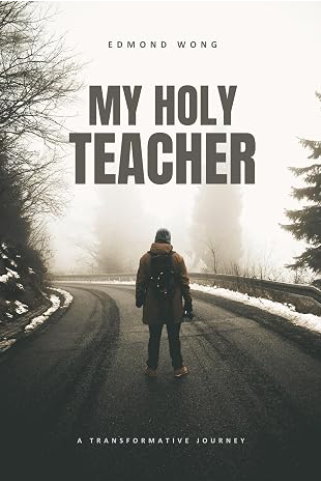
by Edmond Wong
What would you do if an old clay statue cracked open and revealed a living monk who had been meditating inside it for decades?
That unexpected discovery sets Edmond Wong’s My Holy Teacher in motion, but this is not really a story about solving a supernatural mystery. It is a thoughtful, philosophical novel about one family trying to make sense of grief, fear, difficult choices, and the unfairness of life.
I am so grateful to have received a review copy of this fantastic book, and I’m happy to share my thoughts on it with you today, in this spoiler-free review. Let’s dive in!
The Donaldson family arrives at their lakeside vacation home carrying far more emotional baggage than luggage. Peter is facing an ethical crisis at work. His wife, Mary, is questioning how faith and science can exist alongside one another. Their son, Mike, is worried about a sick friend and struggling with the injustice he sees around him.
Vanessa, their adult daughter, is carrying the deepest pain. She is still grieving the death of her husband, Joe, a compassionate army physician who died while helping others. His loss has left her questioning beliefs that once brought her comfort. Why do good people suffer? Why are some lives cut painfully short? How is someone supposed to move forward when the future they imagined has disappeared?
During the vacation, the family discovers a damaged wooden crate hidden in the woods. Inside is a clay statue of a monk. When the statue unexpectedly breaks apart, they discover a living man inside, a mysterious stranger they begin calling Stone.
Stone claims to have spent decades in deep meditation. Although the family is naturally skeptical, they allow him into their home, and he gradually becomes an unusual spiritual teacher.
Big Ideas Grounded in Everyday Problems
Stone’s central belief is that all lives are interconnected. He argues that much of humanity’s suffering comes from seeing ourselves as completely separate from everyone and everything around us.
These ideas could easily feel abstract, but Wong connects them to the Donaldsons’ real struggles. Peter wants to know whether selflessness is realistic in a competitive workplace. Mary questions Stone’s views through both her Christian faith and her scientific background. Vanessa challenges him on grief, death, and why kindness does not always seem to be rewarded.
Stone does not simply deliver speeches while everyone agrees with him. The family questions him, argues with him, and sometimes openly rejects what he says. That back-and-forth makes the story feel more like a genuine exploration of spiritual ideas than a book telling readers exactly what they must believe.
The novel also asks practical questions. Can someone protect their own family while still living compassionately? Does a good action still count as selfless if we expect praise or recognition? How much of a person’s character is shaped by repeated habits? What does success mean if achieving it requires harming someone else?
There are no easy answers, but that is part of the appeal.
A Story About Living with Uncertainty
The emotional heart of the book is Vanessa’s grief.
Her questions are not theoretical. They come from the anger and confusion of losing someone who devoted his life to helping others. Stone does not dismiss her pain or offer a quick explanation that makes everything better. Instead, he encourages her to consider whether love and connection truly disappear when someone dies.
One of the novel’s most comforting ideas is that healing does not mean forgetting. Moving forward does not erase the person who was lost, nor does it make that love less meaningful.
The book also explores faith without treating doubt as a failure. Mary’s conversations with Stone bring Christianity, Eastern philosophy, and scientific reasoning into the same discussion. Readers do not have to agree with every conclusion to appreciate the questions being raised.
Final Thoughts
My Holy Teacher is best suited to readers who enjoy reflective fiction, spiritual parables, and novels built around meaningful conversations rather than fast-paced action.
Edmond Wong has created a sincere and hopeful story about a family meeting an extraordinary teacher at the moment they most need a new perspective. Stone cannot remove their problems or answer every mystery of existence, but he encourages them to look beyond their fear, anger, and assumptions.
The result is a thoughtful novel about compassion, personal responsibility, grief, and the possibility that our lives are far more connected than they appear.
It’s 5 stars from me!