
The Garden of Abel – Book Review
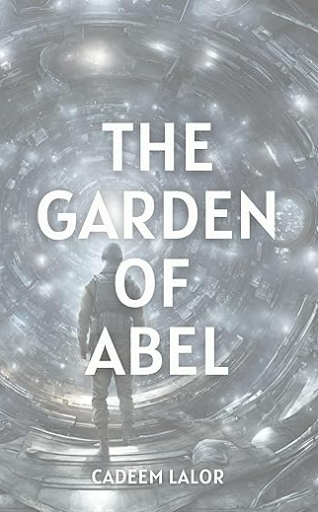
by Cadeem Lalor
I love science fiction and I was very intrigued by the book description of The Garden of Abel by Cadeem Lalor, so I was very excited to get a review copy of this book to explore. I will say right up front, it didn’t disappoint. Read on to learn my thoughts in this spoiler-free review.
A lot of science fiction has explosion, space empires, or futuristic machinery, but The Garden of Abel bring something different – something more daring and fresh.
It decelerates. It glances within. It poses the question, “What happens when world-shattering technology collides with an ordinary, quietly dissatisfied man who never asked to be important?” rather than with heroes or generals.
Our main character, Abel, is a thirty-year-old high school teacher who recently got divorced, is emotionally stagnant, and is going through the motions of a life that doesn’t seem big enough. This profoundly human sense of inertia serves as Lalor’s foundation for the narrative.
Abel is uneasy in a way that is uncomfortably familiar rather than theatrical. He is capable, wise, and kind, but he is unfulfilled. And he’s very humanly relatable. The emotional grounding sets the framework for the science-fiction aspect that weaves in later.
Then we have Adam, a parallel dimension version of Abel. Adam is a scientist working on the development of a dimension-hopping teleporter, representing the life Abel might have led under different conditions. Instead of being a showy gimmick, it turns into a moral weakness. The government in charge of the project sees something far darker in the teleporter’s potential, despite the fact that it was intended to promote international collaboration and trade, colonization, dominance and control.
The Garden of Abel silently sharpens its teeth at this point.
The novel maintains its focus on repercussions rather than evolving into a technobabble-driven epic or a chase-heavy thriller. Adam is escaping the consequences of his own work rather than just a nameless dictatorship. Lalor responds to this with tact and wisdom, and the delivery is very well done. The story’s fascist regime is terrifying because it seems realistic – not cartoonishly evil, but strategic, bureaucratic, and unsettlingly rational in its explanations.
The book is sectioned into fifteen chapters and it’s all very well formatted and easy to read. Chapter one dives immediately into the story with Abel, drawing us in and creating intrigue that will make you want to keep reading. We are pulled into this thoughts and into his world, as it all begins to unfold for us. From this very first chapter, we learn about teleporters and dimension-hopping, something that my frequent readers here will know I am a huge fan of.
But another aspect I really loved about the book is how it examines responsibility in its various incarnations. We see this in Adam and Abel, and for example, the fact that Abel did not build the teleporter. Adam did. Yet both have to accept its existence and what it means for them.
The story poses the question of whether moral responsibility ends with purpose or if it extends to unexpected consequences. The story has a subtle tension that never quite lets go since that question permeates almost every contact.
And as you would imagine from what I’ve said so far, character development is handled well in this story. Abel’s storyline is nuanced but significant. His development comes from having to make a decision, not from suddenly being courageous or intelligent. It is both eerie and profoundly moving to see him struggle with the realization that a different version of himself may change entire worlds. His previous discontent is reframed as untapped potential rather than failure, and this reframing has emotional resonance.
Adam, on the other hand, avoids falling into the trap of being just a “cooler” version of himself. Yes, he is intelligent, but he is also troubled, exhausted, and unethical. He still feels sorrow and dread despite his knowledge. Despite the exceptional circumstances, Lalor allows Adam to stay totally human by resisting the impulse to romanticize him. His friendship with Abel is intriguing rather than ostentatious because of this equilibrium.
This story is thematically rich, but it doesn’t feel overbearing or overwhelming. It naturally incorporates themes of imperial ambition, technological ethics, authoritarianism, and individual agency. There are just circumstances that compel difficult introspection rather than lectures. The end product is a narrative that rewards close attention and honors the reader’s intelligence.
The pacing is also done well. Scenes are given space to breathe as The Garden of Abel is purposefully unfolded. This book lets its ideas evolve naturally rather than hurrying toward them. Instead of constant action, the tension is built through inference, which produces a sense of discomfort that feels more realistic – and frequently more potent – than constant conflict.
Lalor writes in a clear, precise style. The novel’s philosophical inclinations are supported by the writing’s preference for clarity above embellishment. Because they are subtle, emotional moments succeed. The story’s human heart is never overpowered by the infrequent introduction of world-building material. In a genre that occasionally overlooks this balance, it is a welcome decision that the science supports the story rather than the other way around.
The novel’s treatment of speculative technology is another noteworthy accomplishment. The teleporter is intriguing not because of how it operates but rather because of what it makes possible and what it poses a danger to. Real historical analogies are quickly brought to mind by the prospect of accessing less developed realms, and Lalor doesn’t avoid that connection.
The conclusion works quite well. It provides resolution without false comfort. There are still questions. The effects are long-lasting. Despite the want to tidy everything up, the novel ends in a way that feels true to its themes. You’ll keep thinking about it after you put it down.
This is science fiction for readers who choose character over chaos, ethics over explosions, and meditation over spectacle. Stories involving alternate personalities, moral compromise, and the thin line between innovation and oppression will appeal to readers. It is deliberate, restrained, and somewhat eerie.
The fact that this novel leaves the reader wanting more – not in the sense of unresolved narrative lines, but in curiosity about the universe and its possibilities – may be the most persuasive complement one can give it. The concepts presented here seem broad enough to encourage more investigation, especially in relation to the technology at the heart of the narrative and the lives it has already changed.
Science fiction doesn’t have to be loud to be effective, as The Garden of Abel demonstrates. Sometimes all it takes is one common man, one unattainable guest, and one persistent moral dilemma.
It’s 5 stars from me and I would read more from this author.