
Write It Anyway – Book Review
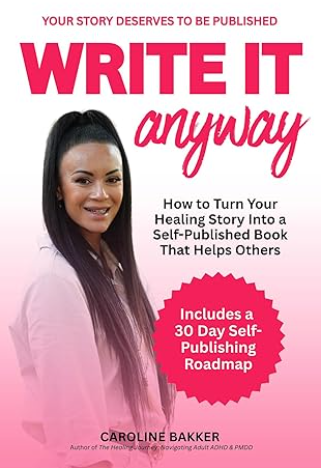
I’ve just finished a review copy of Caroline Bakker’s brand new book, Write It Anyway, and as a reader and an author, it’s fantastic. I’m going to tell you all about it and why I enjoyed it here in this review. And if it sounds like something you can also benefit from, you can grab yourself a copy over on Amazon.
First, this isn’t your standard writing guide. This isn’t about writing the perfect book so much as it is about knowing that your story deserves to be told.
Years ago, I had a coach tell me “Done is better than perfect” and that mantra came to mind when reading this book. She talks about how your story has the power to heal – not when it’s perfect, but when it’s told with truth.
And what does it mean to “tell it with truth”? Well, that’s what the book is going to teach you.
Bakker’s main point is straightforward but radical at the same time: your story can be helpful even if it isn’t finished. But, it must be truthful.
In this book, she will teach you how to find the true message behind your story. The deeper message that you’re trying to share by writing the book. And that’s far more important than anything a dry how-to book can teach you about writing.
Who is the author?
Bakker is a holistic author and coach, and the author of The Healing Journey and Thriving Naturally with ADHD. In Write It Anyway she teaches you the difference between a memoir, a self-help book, and a healing book. And she will give you practical structure and workflow tips in addition to mindset tips for overcoming fear, perfectionism and even procrastination.
As someone who has experienced the tension she is discussing – balancing creativity with ADHD, parenting, exhaustion, and the frequently unseen labor of healing – Bakker writes from personal experience. Every page is shaped by that lived experience. The end product is a book that feels more like a supportive hand on your back telling you to keep going than a lecture. It feels like chatting with a close friend.
The book’s ability to redefine what a “healing book” truly is will be one of the best and most unique parts of it. Bakker skillfully dismantles the notion that writers have to decide between self-help and memoir, presenting transformational writing as a hybrid genre that respects lived experience while providing direction. This distinction is important. Many would-be writers put off writing because they think their narrative isn’t compelling enough for a memoir or credible enough for self-help.
By changing the emphasis from chronology to meaning, Bakker breaks through that immobility. “What did this teach me – and who might need to hear it?” is the new query instead of “What happened to me?”
That shift alone will unlock many stalled manuscripts.
In terms of structure, Write It Anyway is surprisingly useful without seeming chilly or robotic. Bakker guides readers through the process of outlining, drafting, editing, and maintaining consistency in everyday life rather than in a fantasy world of undisturbed mornings and spotless notebooks. Instead of believing that chaos can be optimized away, her workflow guidance recognizes it. This realism is not only beneficial, but also reassuring for writers dealing with neurodiversity, parenting/caregiving, or long-term stress.
In short: You can write a book even if you already have a lot on your plate.
Her approach to fear and perfectionism is equally valuable. Bakker does not pathologize these energies or attempt to use clichés to drive them away. Rather than viewing them as adversaries to be vanquished, she views them as signals to collaborate with within the creative ecosystem.
The book stays grounded and approachable when it shifts to publication logistics. First-time authors may find ISBNs, copyright, formatting, proof copies, and pricing frightening, but Bakker tackles these subjects without mystery or gatekeeping. The section on proof copies is especially good since it reframes the physical book as a creative milestone rather than merely a product. It becomes an act of dedication rather than conceit to see your words on paper. Just that viewpoint could spare readers months of doubt.
When you hold that first copy in your hands, things will shift for you!
Bakker is aware that self-trust, energy control, and nervous system regulation are essential to finishing a book. The guide gains depth from an all-encompassing method without being too obscure. The advice’s continued groundedness in daily reality will be appreciated even by readers who aren’t drawn to spiritual terminology.
The chapters on turning a book into a company and creating an author platform are equally insightful. Bakker favors resonance above performative marketing. She makes a strong case that when the job is based on real service, authenticity scales more effectively than strategy. This framing provides comfort without being foolish for writers who shudder at the thought of becoming a “brand.” She just maintains that self-erasure is not necessary, without disputing the facts of marketing.
From a craft standpoint, Bakker’s writing is straightforward, sympathetic, and purposefully modest. When she can, she stays away from jargon; when not, she clarifies. Throughout, the tone doesn’t change. It’s neither too sentimental nor overtly inspirational. Because of this balance, the book is particularly appropriate for sensitive readers – those who have strong emotions, tend to overthink things, and frequently undervalue the importance of their own voice.
In the end, Write It Anyway is successful because it views writing as a creative and courageous endeavor. It doesn’t guarantee viral launches, instant success, or dreams of passive income. It offers something more nuanced and long-lasting: the capacity to have enough faith in your voice to complete the task at hand.
Write it messy. Write it scared. Write it true.
Bakker doesn’t just say this. She proves it, page by page.